

History and context
Torre Sarrió cannot be understood in isolation: it is part of the defensive network raised in Alicante's Huerta to protect civilians and farmland from the raids of the Barbary corso.
A prosperous huerta on a hostile sea
From the Late Middle Ages, the Huerta of Alicante —irrigated by the Tibi reservoir through a complex system of channels— was fertile land devoted to vine, cereals, fruit trees and Fondillón wine. That prosperity attracted the Barbary corsairs, who from Algiers, Tunis or Bugia ravaged the Mediterranean coast in swift raids —razias— in search of goods, livestock and captives for the slave market.
Throughout the 16th century, the Crown and the municipality articulated a comprehensive defensive system: watchtowers along the coastline, refuge towers inland next to the farmsteads and fortified defence towers linked to the inhabited nuclei. The consulted documentation records up to 43 towers in the Alicante huerta; 25 still stand today, largely absorbed into the urban fabric of Albufereta, La Condomina and Santa Faz.
Wednesday
17
March · 1540
The Barbary raid during the Santa Faz pilgrimage
Coinciding with the annual pilgrimage to the Santa Faz Monastery, the corsairs fell upon the Alicante huerta in a particularly brutal attack. The date remained etched in the city's collective memory and hastened the consolidation of the network of refuge and watchtowers throughout the second half of the 16th century, of which Torre Sarrió (1594) is one of the latest and best documented examples.
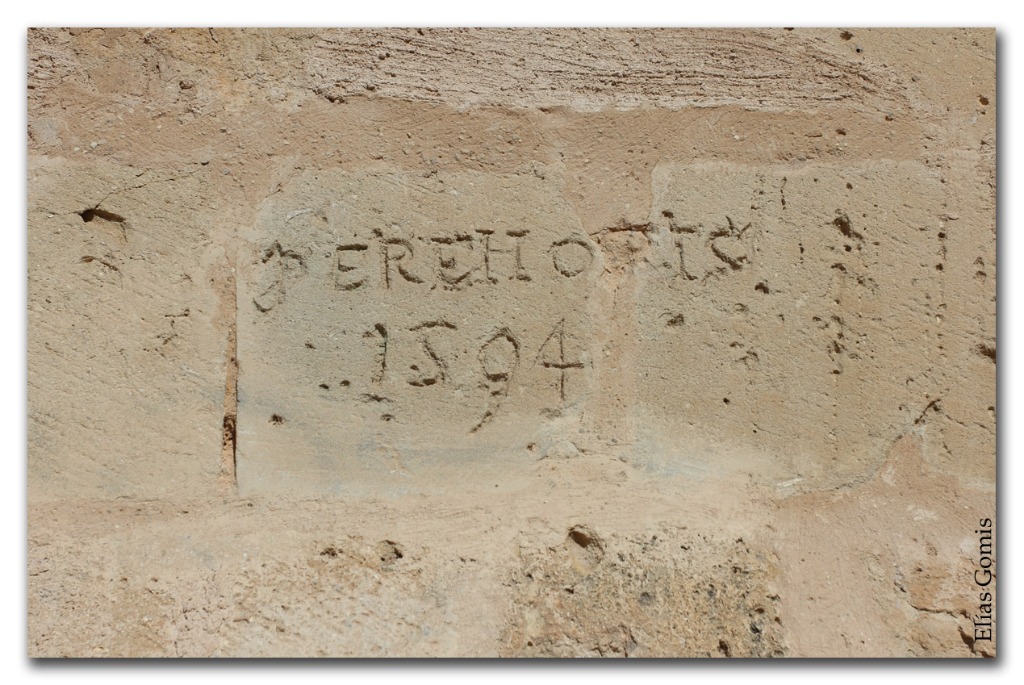
«PERE LLOPIS 1594»
Carved on the talus of the tower —covered until the restoration by almost a metre of fill— appears the inscription of the builder or promoter. Beside the signature, marks interpreted by historians as bullet impacts remain, possibly linked to episodes of the Peninsular War (1808–1814), in which the tower is said to have been the scene of executions.
From fortification to Interpretation Centre
Five centuries of use in three stages: defence (blue), the tower as farming heritage (ochre) and the contemporary period (stone).
- 15th c.
Rise of the North African corso
The Alicante coast suffers increasingly frequent raids by Barbary fleets.
- 17 Mar 1540
Raid on Santa Faz
During the annual pilgrimage, corsairs strike the Huerta hard. The episode speeds up the consolidation of the tower system.
- 1554
Coastal watch ordinances
The chain of alerts —smoke by day, fires by night— is reinforced between the towers and Santa Bárbara Castle.
- 1594
Construction of Torre Sarrió
Pere Llopis signs the inscription on the talus: «PERE LLOPIS 1594».
- 17th–18th c.
Ennobling and attached house
A dwelling is added: the tower shifts from fortification to seigneurial farming residence linked to Fondillón wine.
- 1808–1814
Peninsular War
Impacts on the wall attributed to executions during the conflict.
- 20th c.
Agricultural crisis and abandonment
Phylloxera, water scarcity and rural depopulation degrade the huerta's farms.
- 1995
Final abandonment
Successive fires affect the tower.
- 1998
Roundabout
The building of Vía Parque surrounds the tower and conditions its access.
- 2010
First restoration
Intervention led by architect Màrius Bevià (€420,838). The talus is recovered and cracks consolidated.
- 2021
Second phase of rehabilitation
The architectural enhancement of the tower + house is completed.
- 8 Jul 2026
Opening as Interpretation Centre
Inauguration with content from MARQ and the MARQ Foundation; museography by Rocamora Diseño y Arquitectura.